
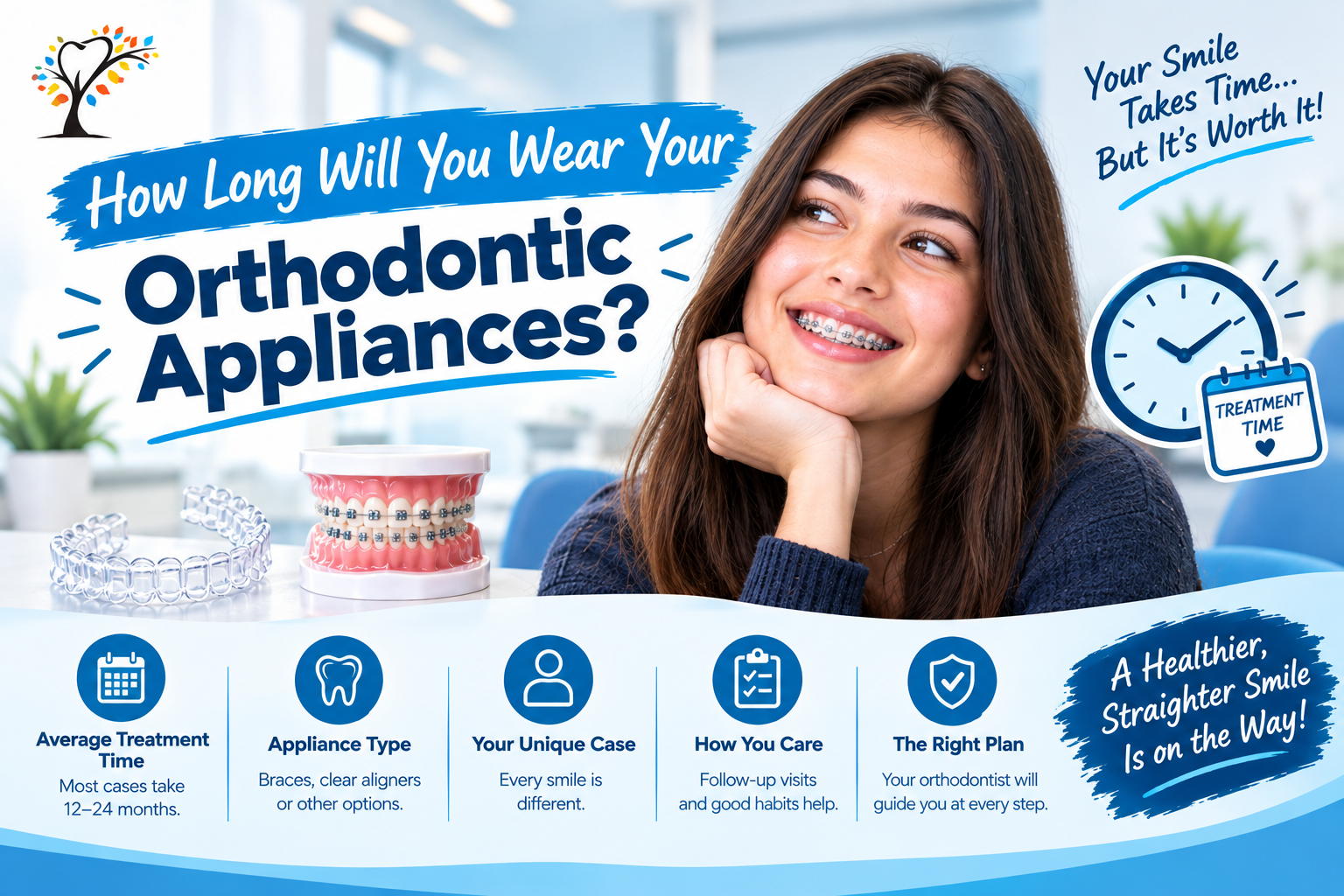
You’ll typically wear orthodontic appliances, like clear aligners or dental braces, for 12 to 24 months. Afterward, you’ll wear a retainer indefinitely to protect and maintain your results.
Whether you are comparing traditional braces to Invisalign, understanding the full duration of the procedure helps you a lot. This guide will provide you with teeth-straightening timelines by case severity. You will also explore the retainer phase and factors that can affect the timeline.
How Long Does Orthodontic Treatment Typically Take?

Most patients wear active braces or aligners for 12 to 24 months. But your exact braces treatment duration depends only on how much correction your teeth actually need.
This range includes most standard cases. However, your orthodontist will give you a more precise orthodontic treatment timeline once they’ve evaluated your specific bite and alignment.
The American Association of Orthodontists reveals that around 4 million people in the USA currently wear some form of braces or aligners. It shows just how common this kind of multi-year commitment really is.
Does Treatment Time Vary by Case Severity?
No one can tell you the exact time for treatment until they examine your teeth. Your treatment duration depends only on how much your teeth need to move. It can range from a few months for a minor case to several years for complex corrections. In the table, we provided a breakdown of the usual timeline by case severity.
Case Severity | Typical Duration | Example Issues |
| Mild | 6 – 12 months | Minor spacing or slight crowding |
| Moderate | 12 – 24 months | Standard overlapping or bite adjustments |
| Severe | 24 – 36+ months | Major crowding, severe overbites, or jaw misalignment |
Mild Cases
Mild cases involve minor spacing or slight crowding that can take 6 to 12 months. Mild cases are among the fastest orthodontists treat. Patients with mild cases are also strong candidates for shorter treatment options, such as Invisalign Express. It can sometimes finish even faster than a full course of standard treatment.
Moderate Cases
Moderate cases involving standard overlapping or bite adjustments generally take 12 to 24 months. It represents the most common average time to wear braces for typical patients.
Severe Cases
Severe cases involving major crowding, significant overbites, or jaw misalignments can take 24 to 36 months or longer. These cases require corrections that need more gradual, careful movement. Patients in this category often see the most dramatic before-and-after results since the starting point involves significantly more correction than milder cases require.
What Happens During the Retainer Wear Phase?
Once active treatment ends, a retainer phase begins to protect your results. This stage typically lasts far longer than active treatment itself. Understanding the duration of retainer wear helps you plan for long-term maintenance.
Full-Time Wear
Full-time retainer wear is usually required for the first 3 to 6 months immediately after braces come off. This helps teeth to settle into their new positions correctly.
Nighttime Wear
After the initial full-time phase, most patients transition to overnight-only wear. This is often recommended for the long term, or even for a lifetime, to prevent teeth from gradually shifting back.
Fixed Retainers
Some patients receive a fixed retainer. They come with a bonded wire placed behind the front teeth that’s often left in place for 3 to 5 years or longer. You do not need to remove it daily. Fixed retainers work well for patients who worry about forgetting removable retainers. However, they still require careful flossing and cleaning around the bonded wire to maintain good oral hygiene.
What Factors Can Change Your Treatment Duration?
Undoubtedly, case severity is the primary factor in treatment duration, but several other factors also affect it. Due to these factors, you may find the difference compared to someone with a similar starting case.
Compliance
Skipping rubber bands or not wearing aligners the full 20 to 22 hours a day adds months to your timeline. Since consistency directly drives how quickly teeth respond to treatment. Even small lapses in compliance can add up over the course of treatment. This is why orthodontists emphasize daily habits just as much as the appliance itself.
Broken Appliances
Breaking brackets with hard or sticky foods can delay your treatment progress. Repair visits may pause active movement until your appliance works properly again. Repeated breakage over the course of treatment can add up to significant delays. This is exactly why dietary guidelines around braces exist in the first place.
Age
Adult bone density can make tooth movement slightly slower than in adolescents. This is because younger patients generally have more responsive, still-developing jaw structures.
Frequently Asked Questions
Can I wear braces for only 3 months?
No, the absolute shortest orthodontic treatment typically takes at least 6 months. Even for very minor cosmetic adjustments, you may need at least 12 months.
Is 4 years too long to wear braces?
Four years is longer than average, but it can be necessary for complex cases. The typical time for wearing braces is 18 to 30 months.
What happens if I don’t wear my elastics for 2 days?
Skipping elastics for two days can stall bite correction and slightly reverse recent progress. However, it won’t ruin your entire treatment.
What happens after 2 months of braces?
After two months, initial soreness fades, and your mouth feels more normal. After that, you can start to see early, visible shifts in your teeth.
Do aligners typically finish faster than braces?
For mild-to-moderate cases, aligners may finish sooner. But overall duration still depends heavily on case complexity and the consistency of daily wear.
How long do I need to wear a retainer after treatment?
Full-time wear is common for the first 3 to 6 months, followed by nighttime-only wear that’s often recommended indefinitely to prevent shifting.
Does age affect how long treatment takes?
Yes, adults often experience slightly slower tooth movement than teens. Adult bone density tends to be higher and less responsive to pressure.
Final Thoughts
Most patients wear active braces or aligners for 12 to 24 months. Mild cases finish faster, and severe cases take longer, followed by a retainer phase that protects results indefinitely. Staying consistent with wear time and appliance care is the major factor in staying on schedule.
Miami Orthodontist is ready to provide you with a personalized treatment timeline for your specific case. Schedule a consultation today and find out exactly how long your journey to a straighter smile could take.
Ready to Transform Your Smile?

Miami Orthodontist Group
Serving Miami & Doral, FL — Two Convenient Locations
Dr. Pedro J. Alquizar and his warm, bilingual team are passionate about creating beautiful, healthy smiles for patients of all ages. We offer Invisalign, braces, and advanced orthodontic treatments using the latest technology — all in a welcoming, upscale environment. Schedule your free consultation today!
Request Your Free Consult
Miami Orthodontist Group
Your Miami Smile Specialists
Invisalign & Braces for children, teens & adults in Miami & Doral, FL. Two convenient locations — request your free consultation today!
Request Free Consult